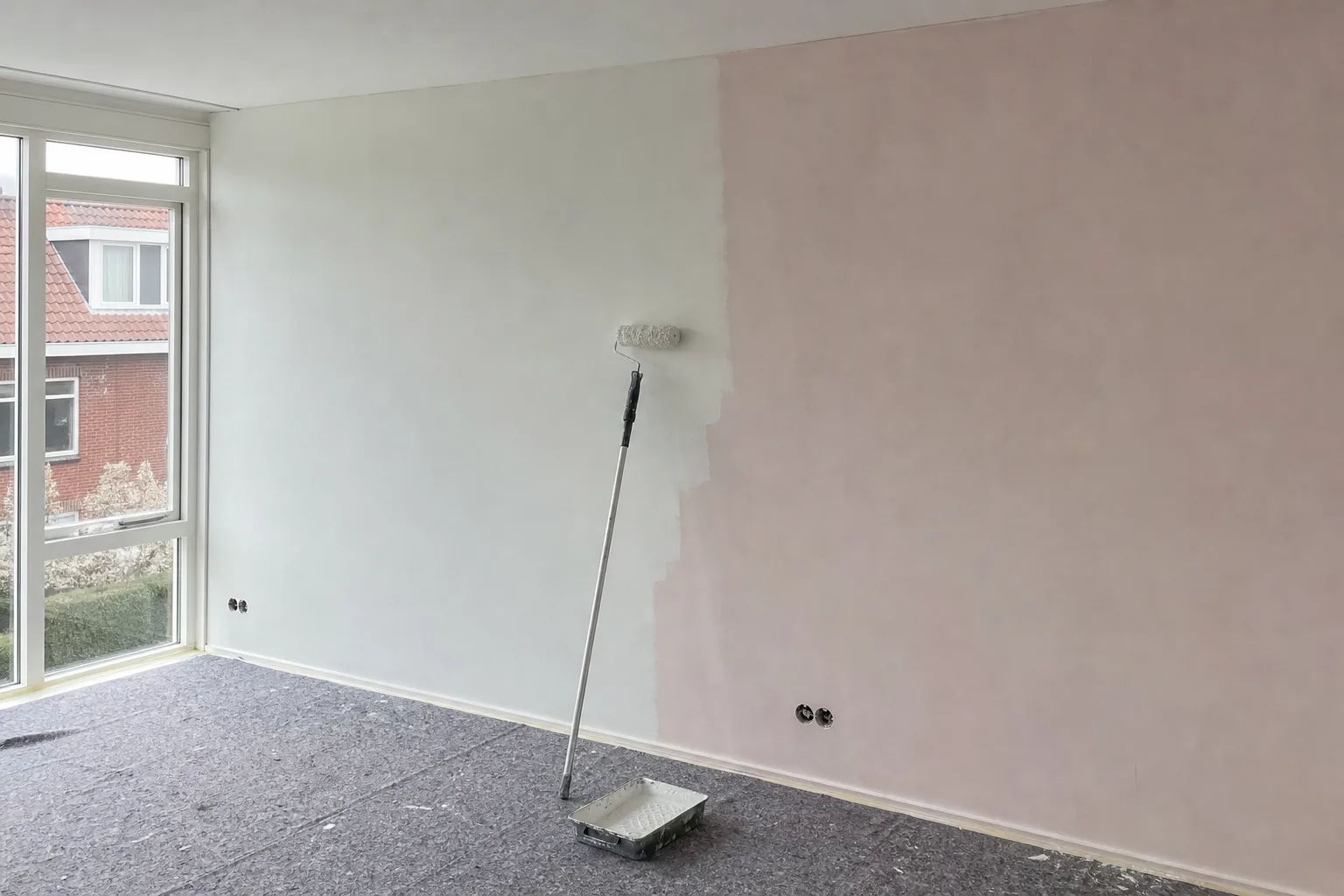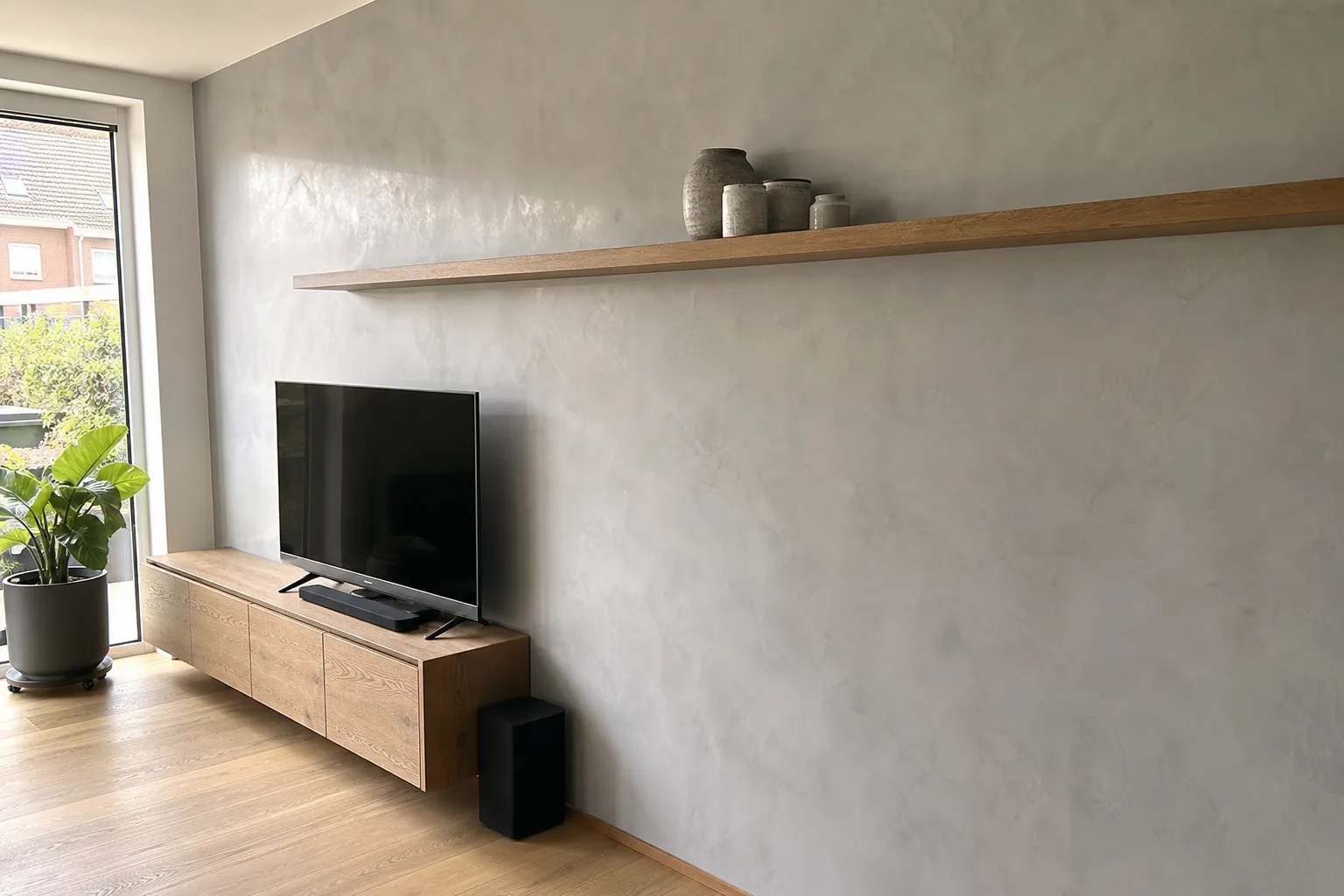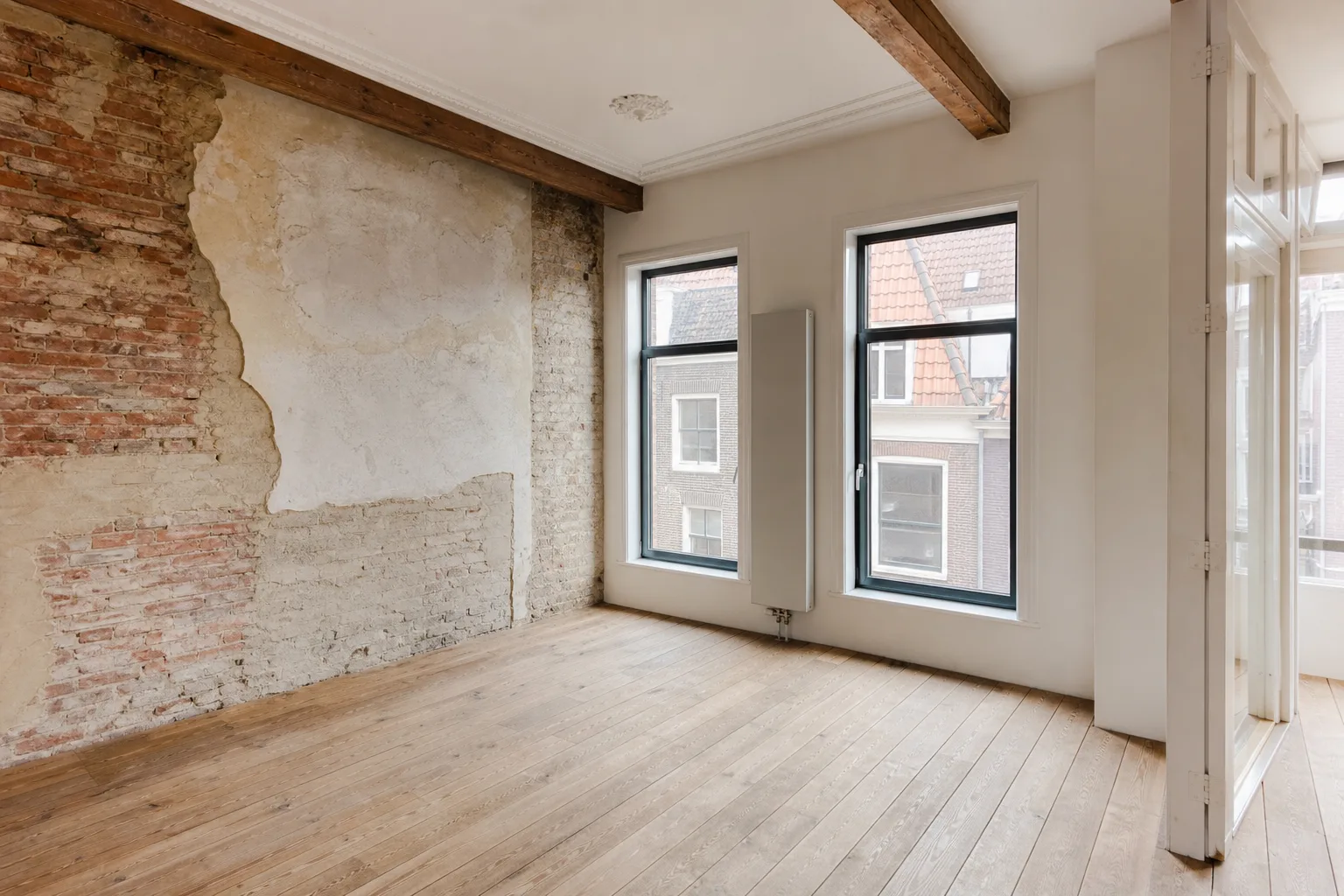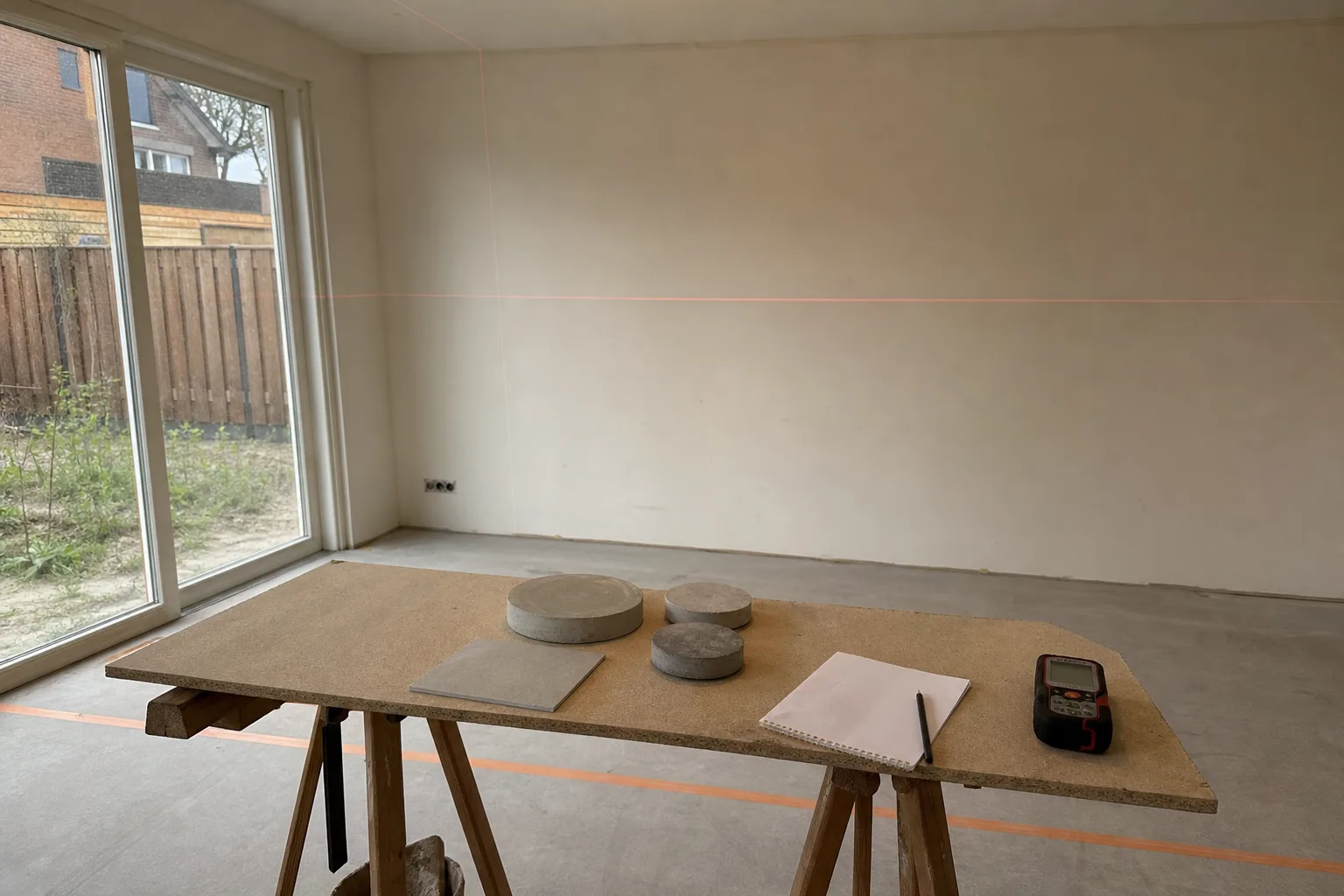
- The base often matters more than the area: old layers, cracks and damp take time.
- Corners, window reveals, openings and ceilings take more work than a flat wall.
- Microcement is several coats with drying time in between, which counts in the hours.
- Masking and protecting a furnished home is work that is often underestimated.
- In the Netherlands, plastering and painting homes older than 2 years falls under 9% VAT, tiling under 21%.
Why a price per square metre misleads
A price per square metre assumes an average wall. But there is no such thing as an average wall. An empty, flat wall of aerated concrete in a new extension is a different job from a wall in a 1930s home with three layers of old wallpaper, chased in pipes and a crack above the door. Both may have the same area. The work differs many times over.
That is why every quote from us starts with a survey. Stas, the owner, comes to look, measures the surfaces, taps the walls and talks through what you want. Only then can we say what is needed. The quote is free and without obligation, and you get a reply within 24 hours of your request.
The base: the biggest unknown
With plastering, preparation often takes more time than the plastering itself. Stripping old wallpaper, removing loose plaster, opening up and reinforcing cracks, filling holes from old pipes and straightening walls that lean. The more that needs doing, the more hours.
In old houses, damp and salts sometimes come into it, or the choice of lime instead of gypsum. See plastering old walls. In homes built before 1994, asbestos can also play a role. According to IPLO, the Dutch government's information point for building rules, buildings from before 1994 are presumed to contain asbestos, and an asbestos inventory is required for demolition work where asbestos is suspected. If an old sprayed coat or board has to come out, that survey can be a separate item in the budget.
- Wallpaper, paint or old textured coats that need to come off.
- Loose or hollow plaster.
- Cracks that need reinforcing.
- Leaning or wavy walls.
- Damp, salts or a base that has to dry first.
Shape of the room and access
A straight wall without openings is quick to finish. Every corner, reveal, niche and window takes extra work: fitting corner beads, finishing neatly and meeting the frames. A ceiling is heavier work than a wall, and a stairwell or high void needs a mobile scaffold. Outside, a facade scaffold comes on top, with the cost of putting it up and sometimes a permit for the pavement.
Access counts too. An upstairs flat on an Amsterdam street with no parking is logistically different from a house with a driveway. Materials have to go up and waste has to come down.
The chosen finish
The technique decides how many coats and how much handwork are needed. Below is where the work mainly sits for each finish. It is not a price ranking, because the base can turn the picture around.
| Finish | Where the work is |
|---|---|
| Smooth plaster | Preparation, coats and getting it flat |
| Spray finish | Masking and protection, then fast spraying |
| Decorative plaster | Handwork, technique, test patch |
| Polished lime plaster | Several thin coats, lots of handwork |
| Exterior render | Scaffold, facade preparation, weather dependent |
| Microcement | Base, waterproofing, several coats with drying time, sealer |
Tip from the trade: When comparing two quotes, do not just look at the total. Check whether both say the same about the base, the number of coats, the waterproofing and the masking. A low price without preparation is not a comparable price.
Snel en kwalitatief hoogstaand werk. 3 kamers opgeleverd in 3 dagen. Gestuukte wanden en plafond. Nu zijn de kamers onherkenbaar. Zulke gladde muren waren hier nooit. Ik adviseer iedereen Parus Construction. Ook de prijzen zullen u verrassen.
Microcement: why it is more than one layer
With microcement you see a thin layer, but underneath is a complete build-up: base repair, primer, waterproofing in wet zones, mesh, base coats, top coats and a sealer. Each coat has to dry and is sanded in between. That is why it takes more time than the surface suggests.
In a bathroom the waterproofing weighs heavily: tape in every corner, collars around pipes and the drain, and a shower floor with the right fall. On a floor, the state of the screed, cracks and movement joints matter a lot. If it can go over existing tiles, that saves demolition. Microcement or tiles compares how much work each finish involves. More on how we work is on the microcement page.
Planning, drying time and the number of working days
Part of the price is not in the area but in the planning. Smooth plastering in one room can be done in one or two working days. Microcement needs several visits, because each coat has to dry before the next can go on. Even if the coat itself goes on quickly, the tradesperson comes back over several days to sand, apply the next coat and finish.
With exterior work, the weather plays a part. Rain, frost or high wind can stop work for a day, and the scaffold then stays up longer. In a renovation with several trades, such as plumbing, electrics, plastering and painting, it helps if they follow on from each other. Waiting time between trades costs money without anything happening. How long plaster takes to dry is explained in plaster drying time.
- Number of coats and drying time between them.
- Number of visits for microcement.
- Weather dependent days for facade work.
- Coordination with other trades in the same project.
VAT: 9% or 21%
For homes older than 2 years, a reduced VAT rate (btw) applies to some types of work. According to the Dutch tax authority, the Belastingdienst, plastering homes older than 2 years falls under the 9% rate, including preparation and the materials used. Work further removed from plastering, such as installing plasterboard walls, fixing tiles to walls and laying floors, falls under 21%.
Painting homes older than 2 years also falls under 9%, including paint materials. Microcement is not mentioned separately on the plastering page. Our quote splits the items by rate, so you can see what falls where. For your own situation, the Belastingdienst is the authority to ask.
What you can do to make the job smaller
You can do part of the preparation yourself if you like. Clear the room as far as possible, take pictures, curtain rails and shelves off the wall, and strip old wallpaper if you have time. That saves hours. Do agree beforehand what you will do yourself, so we can reflect it in the quote.
Combine work as well. If new sockets, pipes or a radiator are needed anyway, have them done before the plastering. At Parus, plastering, electrics and plumbing are done by the same team, so nothing has to be opened up afterwards. For a larger project, see complete renovation. Book a survey through the contact page or on WhatsApp at +31 6 87 61 60 78.
Frequently asked questions
Why don't you list prices on your site?
Because the price depends mostly on the base and the room, and we only see those at the survey. You get a free quote with no obligation, tailored to your home.
Is microcement more expensive than plastering?
It usually involves more work, because microcement is several coats with drying time and a sealer, and needs a waterproofing layer in wet rooms.
Does the 9% VAT rate apply to plastering?
According to the Belastingdienst, plastering homes older than 2 years falls under 9%, including preparation and materials. Tiling falls under 21%.
Can I do the preparation myself to save costs?
Yes, for example clearing the room and stripping old wallpaper. Agree beforehand what you will do, and we will reflect it in the quote.
How quickly do I get a quote?
You get a reply within 24 hours of your request. You receive the quote after the survey.
Renovation and finishing work from Roelofarendsveen: plastering, bathrooms, microcement, extensions, insulation, floors, electrics and plumbing. One point of contact from quote to completion. Questions? Call or WhatsApp +31 6 87 61 60 78.
Sources
- VAT rate for plastering (Belastingdienst, Dutch)
- VAT rate for painting (Belastingdienst, Dutch)
- Asbestos inventory duty: rules in the Bbl (IPLO, Dutch)
Rules change. Always check your own address with the Permit Check (Vergunningcheck) in the Omgevingsloket or with your municipality.