A freshly plastered wall already looks good, but it is not finished. Gypsum is porous, absorbs moisture and marks easily. Only a good coat of paint makes the wall even, wipeable and ready for use. The difference between a clean wall and a patchy one almost always comes down to three things: waiting until the plaster is dry, preparing the first coat properly and choosing the right paint. This guide explains how.
- Only paint once the plaster is completely dry; painting too early causes patches and peeling.
- Gypsum turns lighter as it dries; an even, light colour is the first sign it is ready.
- The first coat is a primer or thinned coat, because fresh gypsum soaks up a lot of moisture.
- Choose a breathable wall paint; dense varnishes and gloss paints do not belong on new plaster.
- Cracks and bumps are filled and sanded first.
Sauzen, emulsion or paint: what is the difference
In Dutch building the words get mixed up. Sauzen originally means applying a thin, matt wall paint to walls and ceilings. Today most people use latex, the Dutch term for a water based emulsion, or another modern wall paint. It is easier to apply, more washable and available in any colour. In this guide, painting means applying wall paint to walls and ceilings, not varnishing frames or doors.
On a plastered wall the principle is the same. The paint has to grip a porous surface, the colour has to come out evenly and the wall has to be able to release moisture. Our plastering page describes how we do it: first we fill cracks and bumps and sand the surface, so the paint grips well and the colour comes out evenly. We work in several coats for a solid, clean result.
When is the wall dry enough
This is the question we hear most, and the answer is: when the whole wall is dry, not when it feels dry. A gypsum layer dries from the outside in. The surface can look dry after a day while there is still moisture deeper down. Wet gypsum is darker and turns lighter as it dries. A wall that is still patchy in colour, with dark areas in corners or on a cold outside wall, is not ready.
How long it takes depends on the thickness, the base, the temperature and above all ventilation. Milieu Centraal, the independent Dutch advice centre for energy and the home, puts it simply: let the plaster dry well before finishing the wall. More on what determines drying time in plaster drying time.
Tip from the trade: Not sure if a wall is dry? Tape a small piece of clear plastic to the wall and leave it overnight. If the inside of the plastic is misted, there is still moisture in the wall.
The first coat: primer or thinned paint
Fresh gypsum is very absorbent. Put a full coat of emulsion straight on and the gypsum pulls the water out of the paint. It grips poorly, dries patchy and may peel later. That is why the first coat is always different from the rest.
There are two common ways. You can use a primer made for new plaster. It soaks into the gypsum, evens out the absorbency and gives grip. Or you apply the first coat of emulsion thinned, as the manufacturer advises. Milieu Centraal mentions this too: with the right preparation, such as a primer, you need less paint. After the first coat you will see every small flaw clearly. That is the moment to touch them up.
Snel en kwalitatief hoogstaand werk. 3 kamers opgeleverd in 3 dagen. Gestuukte wanden en plafond. Nu zijn de kamers onherkenbaar. Zulke gladde muren waren hier nooit. Ik adviseer iedereen Parus Construction. Ook de prijzen zullen u verrassen.
Which paint on new plaster
New plaster needs a wall paint that lets moisture through. A gypsum wall keeps releasing a little moisture after drying, especially in the first months. Dense paints, such as varnish or gloss for woodwork, trap that moisture and can blister or peel. Matt and silk matt water based wall paints are the usual choice.
| Room | Suitable finish | Note |
|---|---|---|
| Living room, bedroom | Matt water based wall paint | Matt hides small flaws |
| Hall and stairwell | Silk matt, washable | More sheen shows more flaws |
| Kitchen | Washable wall paint | Grease and steam: choose a scrubbable grade |
| Bathroom ceiling | Moisture resistant wall paint | Only outside the wet zone, ventilate well |
| Old lime wall | Lime paint or mineral paint | Emulsion seals a breathing wall |
The order in a room
In a room we always work from top to bottom and from light to dark. Ceiling first, then walls. That way splashes and drips land on a surface that still has to be done. The order per wall is fixed as well.
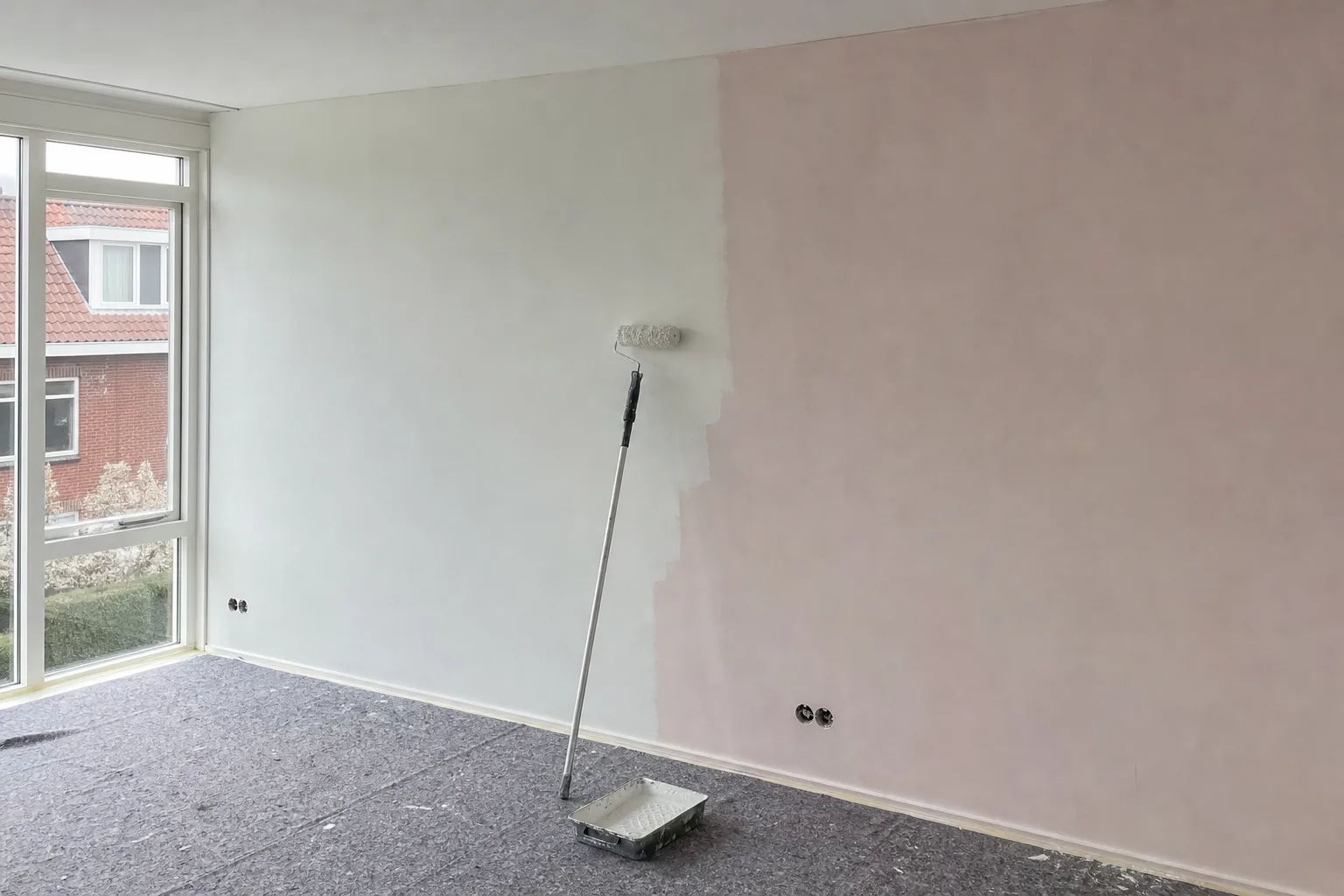
Work each wall from corner to corner without stopping halfway. Cut in along the ceiling, skirting and frames with a small roller or brush first, then fill the surface with a large roller in strips from top to bottom. That way the paint dries evenly everywhere and you will not see edges later.
- Cover and mask the floor, frames, skirting and sockets.
- Check the wall, fill small holes and joints, sand lightly and remove dust.
- Primer or thinned first coat on ceiling and walls.
- Touch up and sand flaws that now show.
- Two covering coats of wall paint, wet on wet per surface, with no lap marks.
- Remove masking tape while the last coat is still just wet.
Common mistakes
Most problems with paint on plaster come from rushing or a wrong order. A few examples we see in practice. Painted too early: the paint peels or dark patches come through. No primer: the paint dries patchy and the colour is uneven. A wall painted in two goes: lap marks that stay visible in side light. A dense paint on an old wall: moisture cannot get out and the paint blisters.
The quality of the plastering itself counts too. A wall finished to wallpaper standard is not always flat enough for paint. If you plan to paint, ask for a paint-ready finish. The difference is explained in smooth plaster or spray finish.
VAT, price and one team for both jobs
According to the Dutch tax authority, the Belastingdienst, painting homes older than 2 years falls under the reduced 9% VAT rate, including preparation and paint materials. Plastering such homes falls under the same rate. We do not list fixed prices; what drives the work is the area, the height, the masking and the number of coats.
If the same team plasters and paints, the work fits together. The plasterer knows paint will follow and delivers a paint-ready finish, and the waiting time between plastering and painting is built into the planning. Parus can do both in one project. See our painting page for more. Stas, the owner, comes to look and you receive a free quote with no obligation, with a reply within 24 hours via the contact page.
Frequently asked questions
How long should I wait to paint after plastering?
Until the whole wall is dry and evenly light in colour. That depends on thickness, base, temperature and ventilation. When in doubt, wait.
Do I need to prime new plaster?
Yes, or apply a thinned first coat. Fresh gypsum is very absorbent, and without preparation the paint grips poorly and dries patchy.
Can I use ordinary emulsion on new plaster?
Yes, a water based wall paint is the usual choice. Do not use dense varnish or gloss paint on fresh gypsum.
Why do I see so many flaws after the first coat?
An even white coat shows the true shape of the wall. That is the moment to touch up small spots before the covering coats go on.
Do you also do just the painting?
Yes, we can paint walls and ceilings even if the plastering is already done. At the survey we check whether the surface is good enough.
Renovation and finishing work from Roelofarendsveen: plastering, bathrooms, microcement, extensions, insulation, floors, electrics and plumbing. One point of contact from quote to completion. Questions? Call or WhatsApp +31 6 87 61 60 78.
Sources
Rules change. Always check your own address with the Permit Check (Vergunningcheck) in the Omgevingsloket or with your municipality.