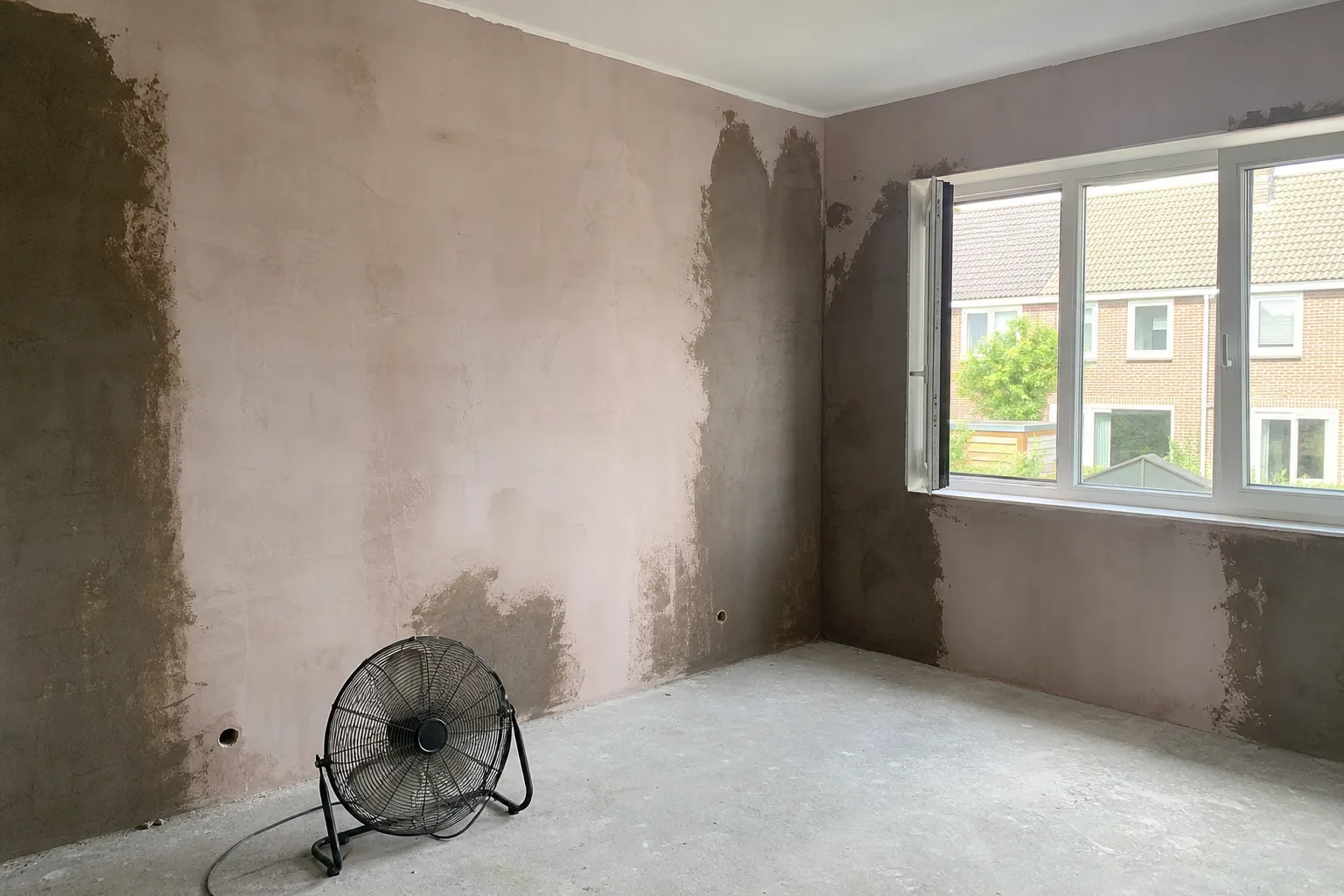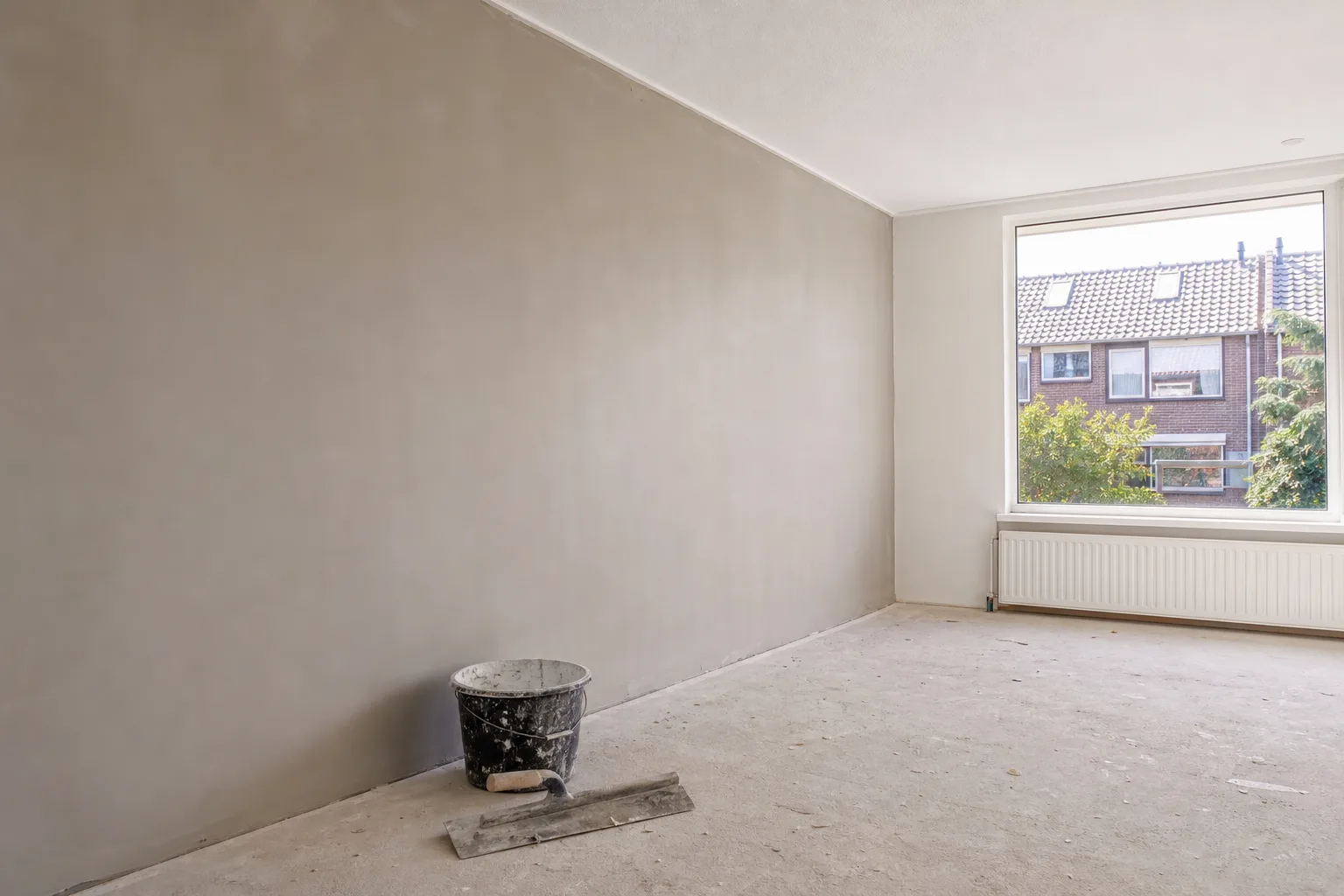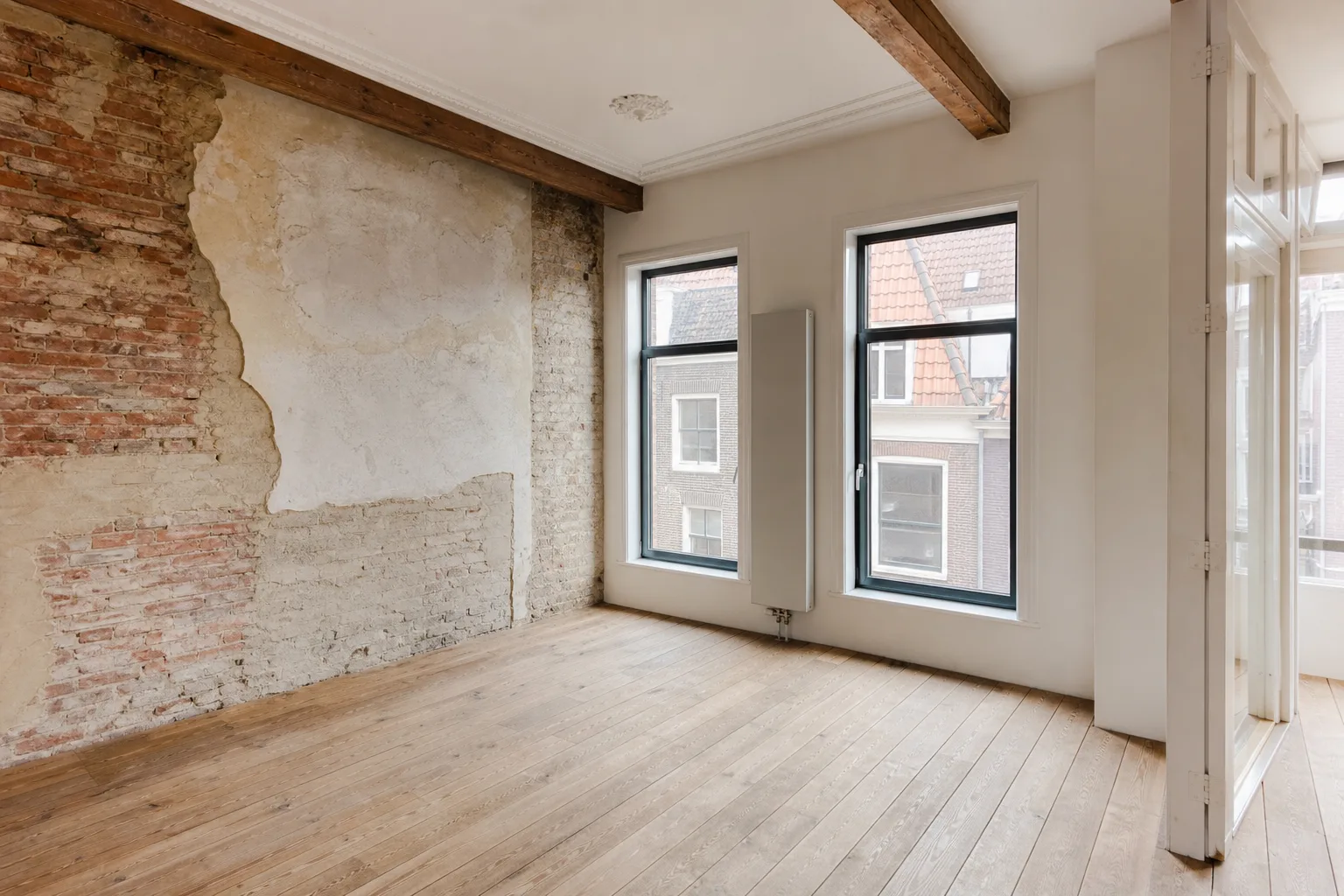
An old house needs different plastering from a new build. A canal house (grachtenpand) in Amsterdam, Leiden or Haarlem often has solid walls laid in lime mortar, ceilings of plaster on reed and sometimes centuries old cornicing. A 1930s home in The Hague or Utrecht has its own quirks: solid brick walls, reed ceilings and cracks in the same places every time. Treat such a house like a new build and within a few years you get loose plaster and damp patches back. This guide explains what is inside old walls, which materials fit and when to check the rules first.
- Old walls are often laid in lime mortar and need to release moisture; breathable materials such as lime suit them better.
- A dense finish on a damp old wall traps moisture and the plaster comes loose after a few winters.
- Ceilings of plaster on reed or laths can often be repaired rather than replaced.
- In homes built before 1994, asbestos is presumed to be present for demolition work.
- For a national listed building, almost any change needs a permit, inside as well.
What is inside an old wall
A wall in a canal house is usually solid: brick laid in lime mortar, sometimes more than one brick thick, with one or more coats of lime plaster on the inside. Lime is soft and breathable. The wall takes on moisture when it rains and releases it when it dries. That system has worked for centuries, as long as nothing dense goes on top.
1930s homes were often built with a cavity, but there too you find lime and lime cement mortars, internal walls of brick or aerated concrete and sometimes old plaster coats reinforced with hair or straw. Ceilings in both types of house are often made of plaster on reed mats or timber laths, fixed under the joists. Those ceilings are heavier and stiffer than they look, and they move with the timber floor above.
Why lime often beats gypsum
In new builds, gypsum is the standard for interior plastering. It is fast, flat and affordable to apply. On an old solid wall that needs to release moisture, gypsum is not always the best choice. Gypsum does not cope well with lasting damp, and emulsion or another dense paint on top seals the wall even more.
According to Milieu Centraal, the independent Dutch advice centre for energy and the home, lime and clay plasters, lime and clay paints and mineral paints let moisture through, while latex paint, tiles and cement hold it back. The Cultural Heritage Agency (Rijksdienst voor het Cultureel Erfgoed, RCE) advises that historic masonry built with lime is in most cases best repaired with lime mortar again. So on old external walls and at damp prone skirting level, lime plaster is often the better choice, finished with lime paint or a mineral paint.
On internal walls that are dry and have no contact with the outside, gypsum works fine. It is about the right material in the right place, not a fixed rule.
| Situation | Suitable material | Why |
|---|---|---|
| Solid external wall, canal house | Lime plaster, lime paint | The wall must release moisture |
| Skirting level with salts or rising damp | Lime or a repair plaster | Gypsum and emulsion come loose |
| Dry internal brick wall | Gypsum or lime | No lasting moisture |
| Ceiling of plaster on reed | Repair with lime or a matching plaster | Moves like the original |
| 1930s internal wall with cracks | Gypsum with mesh, or lime | Deal with the cause of the crack first |
Damp, salts and cracks
Almost every old wall has a story. White bloom at the bottom of a wall points to salts carried up by moisture. Plaster that sounds hollow when tapped is loose. A crack running diagonally from the corner of a window can point to settlement or a moving lintel. Before new plaster goes on, we find out where the problem comes from.
Damp often comes from outside: a leaking gutter, a broken mortar joint, ground level too high against the facade. Plastering does not fix that. Cause first, repair second. Salts are removed as far as possible and the plaster is matched to the wall, so salt and moisture can escape without pushing the finish off.
With cracks, we check whether they are still moving. An old, stable crack is opened, filled and reinforced with mesh. A crack that keeps growing needs a structural assessment first. Plastering makes no sense until then.
Tip from the trade: Planning to insulate an old external wall on the inside? Discuss it beforehand. An inner insulated wall changes how the wall dries, and the internal finish must be matched to that.
Ze hebben in 1 week tijd de hele beneden verdieping stucwerk gerepareerd, geschilderd en gesausd tot volle tevredenheid. Netjes en accuraat gewerkt, flexibel geweest en vakwerk afgeleverd. Dus top.
Old ceilings: repair or replace
A ceiling of plaster on reed or laths with cracks does not always have to go. Often most of it is still firmly fixed and only the cracks and a few loose areas are the problem. Those areas are fixed back, the cracks reinforced and the whole ceiling gets a new finishing coat. That keeps the original ceiling, its height and its cornicing.
If large parts of the ceiling are loose or sagging, replacement is sometimes better, for example with plasterboard on a new frame. That gives a flat surface but also changes the character. In a listed building, that is a change you need permission for first. Cornicing and ceiling roses can often be repaired or recreated from a mould of the existing profile.
In homes built before 1994 we look out for asbestos when opening things up. According to IPLO, the Dutch government's information point for building rules, buildings from before 1994 are presumed to contain asbestos. Think of later additions such as boards around a chimney breast or an old sprayed coat on the ceiling. When in doubt, it should be tested first.
Listed buildings and protected areas
Many canal houses are national or municipal listed buildings (monuments), or stand in a protected townscape. According to the Cultural Heritage Agency, you generally need an environment and planning permit (omgevingsvergunning) for any change to a protected monument. Small, routine maintenance where material, colour, shape, detailing and profiles stay the same does not need a permit.
The protection applies inside too. Plaster ceilings, cornicing and historic wall finishes can be part of the listed value. Replacing a ceiling or swapping an old lime coat for gypsum is then no longer maintenance. We do not give permit advice. Business.gov.nl explains the rules for monuments in English; check your own situation in the Omgevingsloket, the government's online portal, or talk to your municipality (gemeente) first.
1930s homes: the usual spots
In 1930s homes we keep seeing the same points. Cracks above doors and in the corners of the stairwell, where the timber structure moves. Reed ceilings covered by decades of paint or wallpaper. And internal walls where pipes and boxes have been chased in over the years and roughly filled again.
In a renovation, this is the moment to put electrics and plumbing right first, before new plaster goes on. At Parus, plastering, electrics and plumbing are done by the same team, so nothing needs to be opened up after plastering. If you want something other than a smooth finish after the repair, see decorative plaster and concrete look. For the outside, read exterior render on the facade.
- Cracks above doors and in the stairwell.
- Reed ceilings under layers of old paint or wallpaper.
- Chased and roughly filled pipe channels.
- Old lime coats coming loose under newer gypsum.
How we approach an old house
With an old house, the work starts with looking and tapping. Stas, the owner, comes round, checks the walls and ceilings and asks about the history of the house: leaks, earlier renovations, listed status. You then receive a free quote with no obligation, describing what each room needs and which material we propose where.
We do not list fixed prices. In an old house, the state of the base mostly decides how much work it is: how much is loose, whether there are salts and damp in the wall and whether ceilings need repair or replacement. More about our plastering on the plastering page, and if you also want to insulate, see insulation.
Frequently asked questions
Can I use gypsum on an old wall?
On a dry internal wall, yes. On a solid external wall or at skirting level with damp and salts, lime is the better choice, because it lets moisture through.
Does an old reed ceiling with cracks have to come down?
Not always. Often most of it is firmly fixed and the cracks and loose areas can be repaired. If large parts are loose, replacement is sometimes better.
Do I need a permit for plastering in a listed building?
For a national listed building, almost any change needs a permit, inside as well. Maintenance where material, colour and shape stay the same does not. Check the Omgevingsloket or ask your municipality.
Why does my plaster keep coming loose at the bottom of the wall?
Usually because moisture and salts come out of the wall. A dense plaster or paint holds them back until they push it off. Fix the cause first, then use a matching plaster.
Do you work in Amsterdam and Leiden?
Yes, we work within about 70 km of Roelofarendsveen, including Amsterdam, Haarlem, Leiden, The Hague and Utrecht.
Renovation and finishing work from Roelofarendsveen: plastering, bathrooms, microcement, extensions, insulation, floors, electrics and plumbing. One point of contact from quote to completion. Questions? Call or WhatsApp +31 6 87 61 60 78.
Sources
- Environment and planning permit: renovating or demolishing protected monuments (Business.gov.nl)
- The use of lime mortar (Cultural Heritage Agency, Dutch)
- Asbestos inventory duty: rules in the Bbl (IPLO, Dutch)
- Insulating an external wall with an inner wall (Milieu Centraal, Dutch)
Rules change. Always check your own address with the Permit Check (Vergunningcheck) in the Omgevingsloket or with your municipality.