Facade render protects the outside wall from moisture and weather, and gives a house a neat, even look. It can go on brickwork, on concrete and on insulation boards, and it is increasingly combined with external wall insulation. Outside, a plaster layer works in very different conditions from inside: rain, frost, sun and wind. This guide explains the types of render, what the wall needs first, when the weather is good enough and when you need to check whether rules apply to your facade.
- A facade render has to keep water out while letting moisture escape from the wall.
- The base must be firm, clean and sound; salts, algae and loose joints are dealt with first.
- Render can go on insulation boards, so insulating and finishing happen in one project.
- No rendering in frost, heavy rain, strong sun or high wind.
- If the look of the facade changes, or the house is in a protected area or is a listed building, check the rules first.
Why render a facade
People choose exterior render for different reasons. Sometimes the brickwork is weathered, or years of repairs with different bricks have left the facade looking patchy. Sometimes the owner wants a cleaner, more modern look. And more and more often, render is the finish over a layer of external insulation.
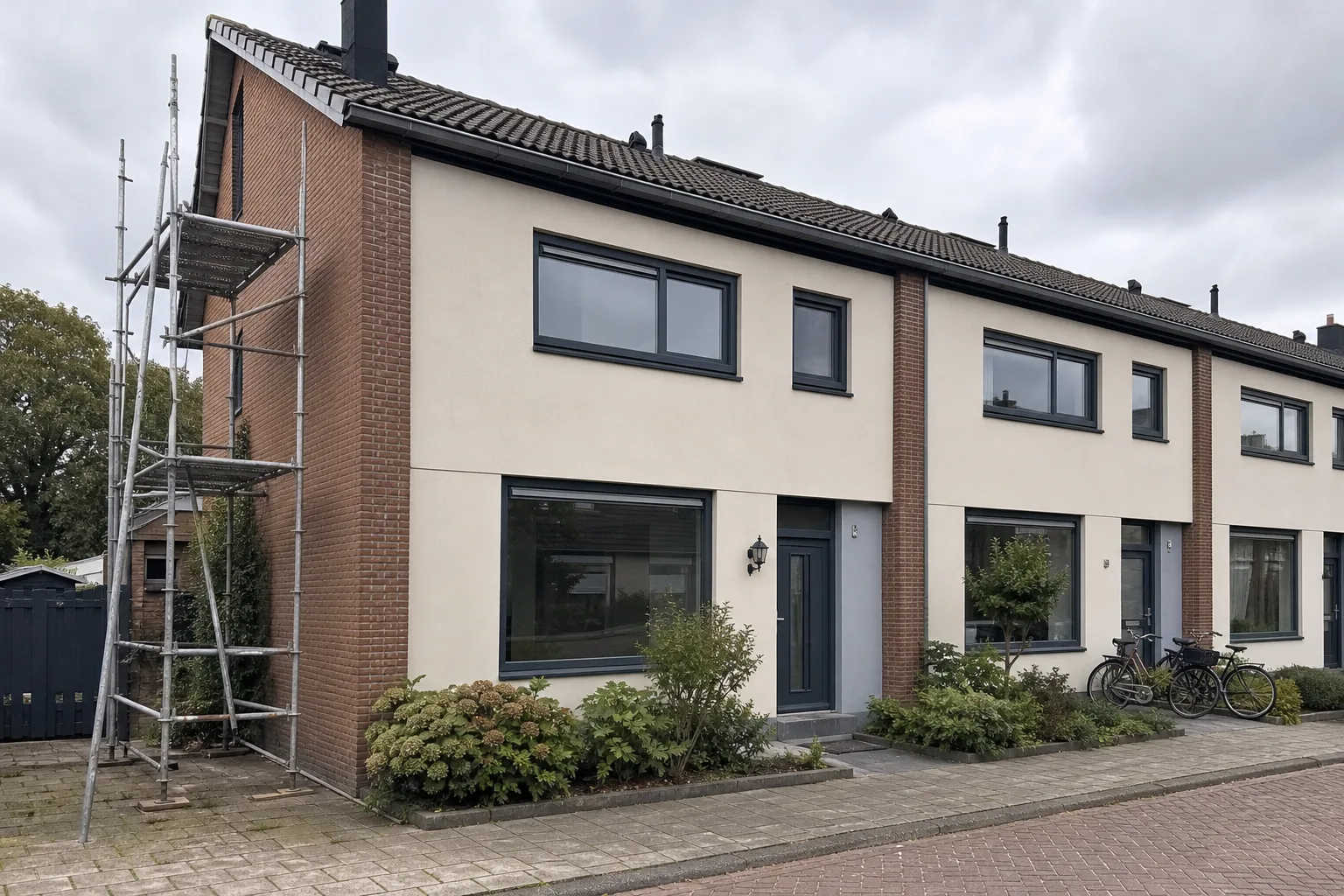
A good render protects the wall against driving rain and stops water soaking deep into the brickwork. For that the system has to be right: the right plaster on the right base, with attention to where it meets window frames, the roof edge and the ground. Our plastering page shows a project where we applied render over insulation boards, with a beige finish around the window frames, working from a scaffold wrapped in shrink film for protection.
Types of facade render
There are several render systems for outside use. They differ in binder, strength, breathability and look. Which one fits depends on the wall and on what sits behind the render.
| Type | Properties | Suits |
|---|---|---|
| Lime render | Soft, breathable, flexible | Old, solid walls |
| Lime and cement render | Stronger, still fairly breathable | Brickwork in good condition |
| Mineral decorative render | Textured, paintable, breathable | Finish coat over a base coat |
| Acrylic render | Water repellent, available in colour | Systems on insulation board |
| Silicone render | Strongly water repellent and breathable | Facades with heavy rain exposure |
Tip from the trade: On an old wall built with lime mortar, a render that is too hard and dense is a well known mistake. Moisture gets trapped and pushes the render off after a few winters.
Preparing the wall
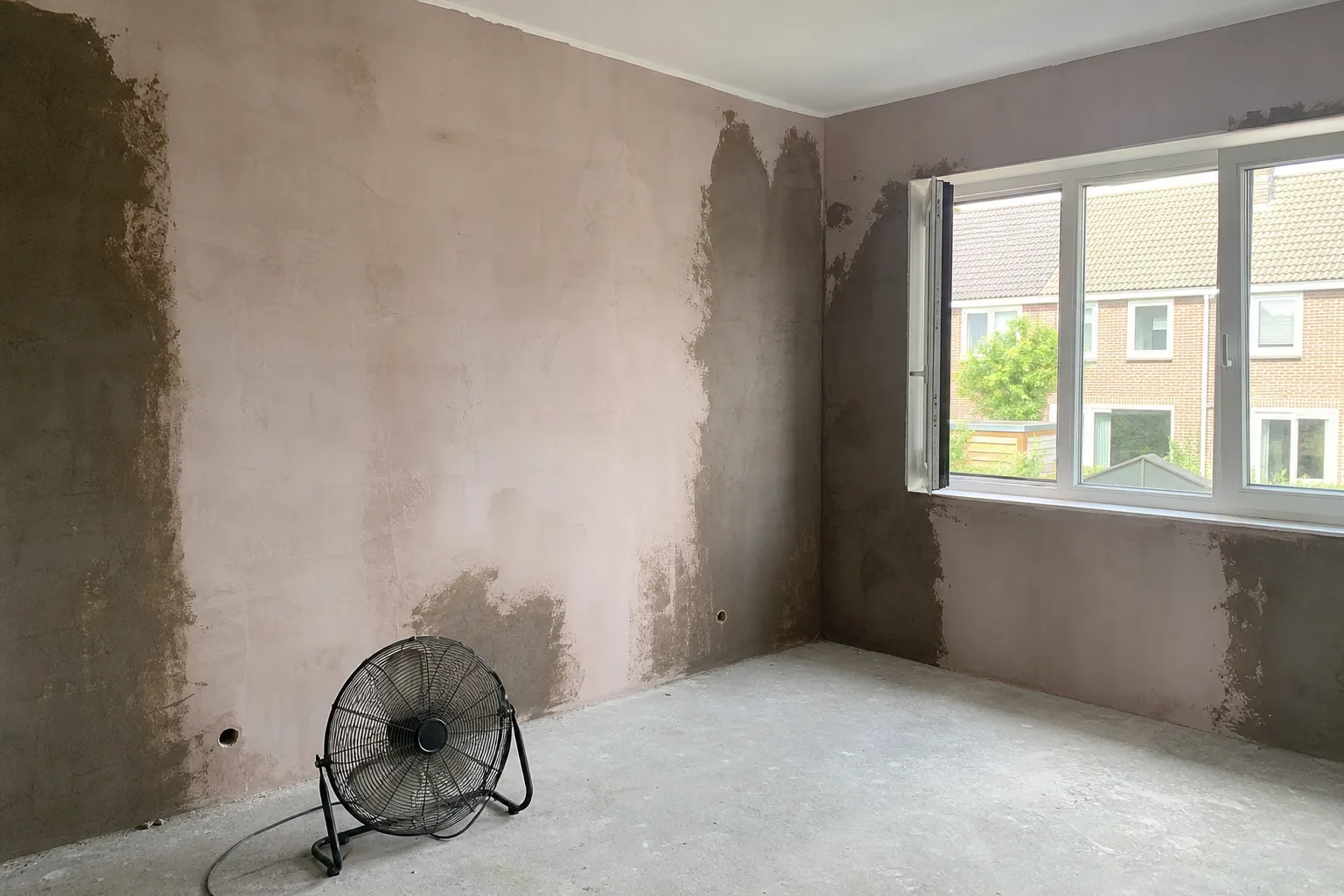
Outside, preparation matters even more than inside. We first check whether the wall is dry and sound. White bloom points to salts, green growth to algae and damp, loose mortar joints to a wall that needs maintenance first. Render over a wet or salty wall does not last.
The facade is then cleaned, loose material removed and cracks repaired. Where the base absorbs a lot or unevenly, a primer goes on. On smooth surfaces such as concrete we use a bonding coat. On old walls with lime mortar, follow the advice of the Cultural Heritage Agency (Rijksdienst voor het Cultureel Erfgoed) that historic masonry built with lime is in most cases best repaired with a lime mortar.
- Check the wall for damp, salts and algae.
- Clean it and remove loose material.
- Repair cracks and joints.
- Primer or bonding coat to suit the base.
- Fit corner beads, reveal beads and a base profile.
Ze hebben in 1 week tijd de hele beneden verdieping stucwerk gerepareerd, geschilderd en gesausd tot volle tevredenheid. Netjes en accuraat gewerkt, flexibel geweest en vakwerk afgeleverd. Dus top.
Render over insulation
With external wall insulation, insulation boards are glued and fixed to the wall. A reinforcing coat with mesh goes over them, then the finishing render. The wall is insulated and the house gets a new facade at the same time. The advantage is that you lose no space inside, and cold bridges at floors and internal walls are largely covered.
With a system like this, the details count. Where it meets window frames, sills, the roof edge and the base must be watertight, and because the facade gets thicker, roof overhangs and downpipes move too. At Parus, insulation and plastering are done by the same team. Read more about insulation on our insulation page.
The choice of insulation board matters too. There are rigid and softer boards in different thicknesses, and not every board suits every render. Insulation, adhesive, mesh and finish belong together as one system. That is why a complete system is better than loose components, so the layers are matched and the facade works as a whole.
The right weather for rendering
An exterior render needs calm conditions to cure. In frost the water in the fresh layer freezes, in heavy rain the render washes out, and in strong sun or high wind it dries too fast and gets shrinkage cracks. So facade work means checking the forecast every day and screening the scaffold with mesh or sheeting when needed.
In practice that means facade work is best planned from spring to autumn, outside the real frost period. Even then a week of heavy rain can shift the schedule. That is part of the job. A facade that is rushed will show it within a few seasons. For drying times in general, see plaster drying time.
Permits, listed buildings and owners' associations
We do not give permit advice, but here are a few points to keep in mind. Rendering a facade changes the look of your house. Whether you need an environment and planning permit (omgevingsvergunning) depends on the location, the side of the house and the rules of your municipality (gemeente). Use the permit check in the Omgevingsloket, the government's online portal, or ask your municipality first. The portal is in Dutch; Business.gov.nl explains the main rules for monuments and protected areas in English.
If your house is in a protected townscape or is a listed building, extra rules apply. According to that same page, routine maintenance in a protected area is exempt if colour and material stay the same, while changes to a listed building usually need a permit. If you live in an apartment, the facade is usually a shared part of the building and the owners' association (VvE) has a say.
Upkeep and how to start
A rendered facade needs little, but not nothing. Check once a year for hairline cracks at frames and corners, whether sealant joints are still closed and whether gutters and downpipes leak. Water running down the facade from a leaking gutter is the biggest enemy of exterior render. Green growth on the north side can be removed with a suitable cleaner. A mineral facade can be repainted after some years with a breathable masonry paint.
We do not give amounts here. What drives the price is the area, the scaffold, the state of the wall, the render system and whether insulation goes underneath. Stas, the owner, comes to look at the facade and you receive a free quote with no obligation. Book the survey through the contact page.
Frequently asked questions
Can any facade be rendered?
Most can, if the wall is dry, sound and strong enough. A wet or salty wall must be dealt with first, otherwise the render comes loose.
When can exterior rendering be done?
In dry weather without frost, strong sun or high wind. Facade work is best planned from spring to autumn, and the weather decides day by day whether work can go ahead.
Do I need a permit to render my facade?
That depends on your municipality, the location and the status of the house. Use the permit check in the Omgevingsloket or ask the municipality. For listed buildings, changes almost always need a permit.
Can render go over insulation boards?
Yes, that is a common system: insulation board, a reinforcing coat with mesh and a finishing render. You insulate and get a new facade in one project.
How long does a rendered facade last?
With a good system, neat details and a short check every year, a facade lasts a long time. Leaking gutters and open sealant joints are the biggest risks.
Renovation and finishing work from Roelofarendsveen: plastering, bathrooms, microcement, extensions, insulation, floors, electrics and plumbing. One point of contact from quote to completion. Questions? Call or WhatsApp +31 6 87 61 60 78.
Sources
- Permit check (Omgevingsloket, Dutch)
- Environment and planning permit: renovating or demolishing protected monuments (Business.gov.nl)
- The use of lime mortar (Cultural Heritage Agency, Dutch)
Rules change. Always check your own address with the Permit Check (Vergunningcheck) in the Omgevingsloket or with your municipality.