- Flatness, moisture, strength and adhesion decide whether a subfloor is ready for a new floor.
- PVC and bonded parquet need a flatter subfloor than a floating floor.
- Old vinyl, sheet flooring or floor tiles can contain asbestos; Dutch rules presume asbestos in buildings from before 1994.
- A levelling layer has to dry before the floor goes on; thickness, temperature and ventilation decide how long.
- Timber floors are fixed down first and usually covered with boards before any levelling.
Why the subfloor matters so much
A floor follows whatever is under it. Thin floors such as glue-down PVC show every irregularity once the light falls across them. A dip under a floating floor gives a springy spot and, over time, an opening joint. A ridge or old tile joint pushes through. Moisture in the subfloor gets into wood and makes it swell, or makes glue let go.
So preparation is not a side issue. It is often the largest part of the job, and the part you no longer see once the floor is finished. A good floor layer always assesses the subfloor before giving a price. Skipping that step looks cheaper on paper and leads to complaints later.
What we check during the site visit
During the visit we lay a long straightedge on the floor and see how much space there is underneath. That shows us where the floor dips or bulges. The moisture in the screed should be measured too, especially in a new extension or over a crawl space, which most Dutch ground floors have. We tap the floor to find loose parts or hollow tiles. And we look at what is there now: tiles, old vinyl, carpet with glue residue, a timber floor or bare concrete.
Height matters too. A new floor with underlay and possibly levelling raises the floor. That affects doors, thresholds, stairs and the join with the kitchen or bathroom. We discuss this in advance, so there are no surprises when a door no longer opens.
- Flatness with a straightedge across the whole room.
- Moisture content of the screed.
- Strength: loose parts, hollow tiles, cracks.
- Current floor covering and glue residue.
- Height relative to doors, thresholds and adjoining rooms.
Removing old floors, and asbestos
Often something has to come out first: carpet, laminate, old vinyl or a tiled floor that has come loose. We then scrape or grind off glue residue so the new layer bonds well. A firm, flat tiled floor can sometimes stay. We then fill the joints and level over it after applying a bonding primer.
With old floors we watch out for asbestos. According to Milieu Centraal, the independent Dutch information service, vinyl sheet flooring sold between 1963 and 1983 can have an asbestos paper backing, and vinyl floor tiles reinforced with asbestos were sold until about 1985. Milieu Centraal warns against pulling up such sheet flooring, because the asbestos paper can tear. IPLO, the government information point on building rules, explains that buildings from before 1994 are presumed to contain asbestos. If in doubt, work should stop until the material has been tested.
Tip from the trade: If you find old sheet vinyl with a grey, felt-like backing under your carpet or laminate, do not pull it up yourself. Have it identified first.
Met dit bedrijf werk ik niet voor het eerst samen. Ze hebben voor mij verschillende werkzaamheden uitgevoerd, zoals het vervangen en maken van deuren, het realiseren van een aanbouw en het uitvoeren van binnenrenovaties. De jongens zijn zeer verantwoordelijk, en vooral Stanislav geeft altijd goede adviezen.
Repairing and priming
Before levelling we repair whatever is damaged. Cracks in the screed are opened up and filled. Loose sections are removed and rebuilt. Deep holes, for example where an old pipe ran or a wall was taken out, are first filled with a repair mortar.
Then comes a primer. It makes the levelling compound bond and stops the subfloor from drawing water out of it too quickly. If the base absorbs too fast, the compound dries too quickly and can crack or come loose. On smooth tiles we use a bonding primer made for non-absorbent surfaces. Along the walls we lay an edge strip so the compound does not bond to the wall.
Levelling: thickness and drying time
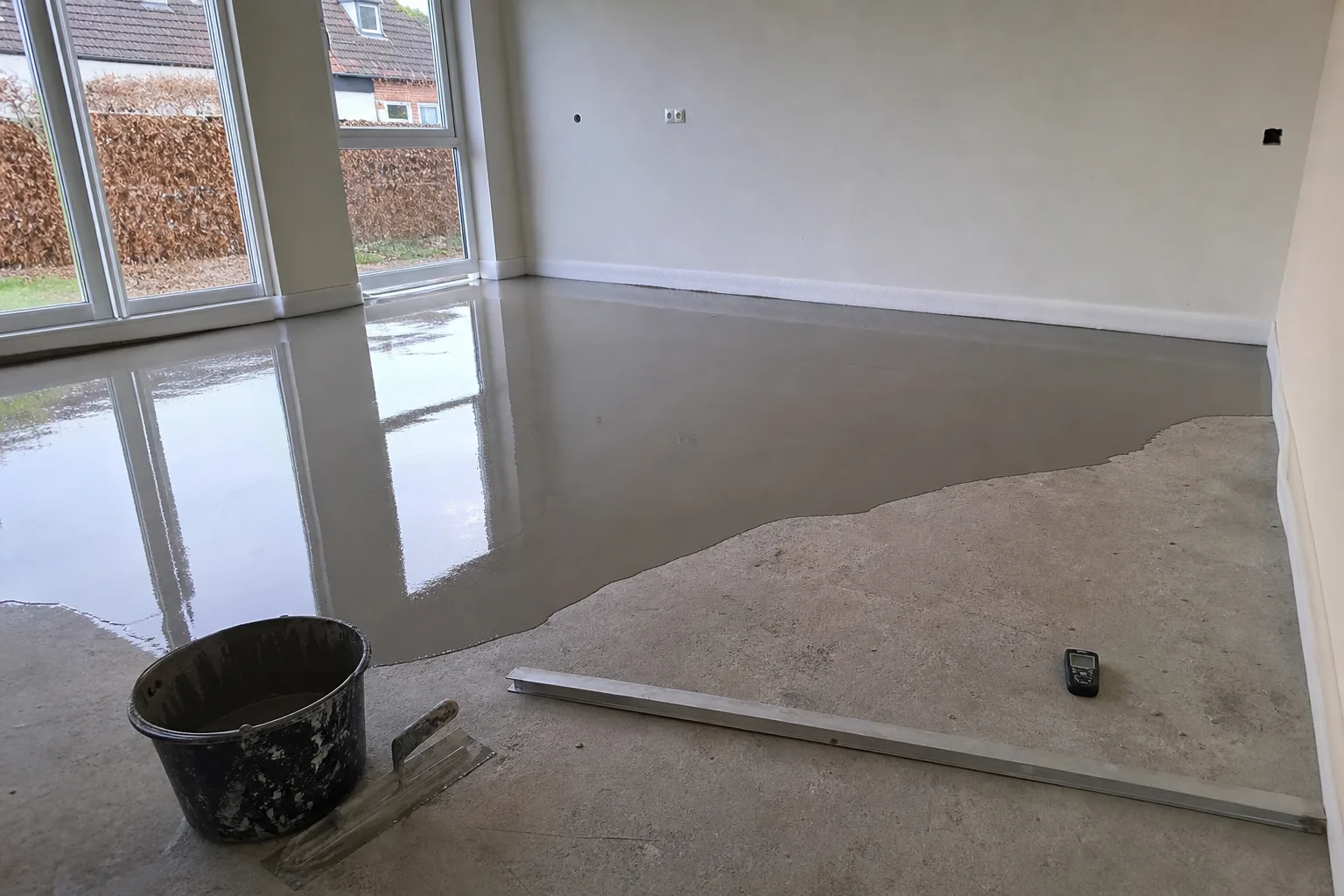
Levelling compound is a liquid mortar that largely levels itself. We mix it in the right ratio, pour it out in strips and spread it with a trowel and a spiked roller to remove air bubbles. The thickness depends on how far the floor is out, and each product has a minimum and maximum layer thickness. With large level differences we work in several layers or start with a thicker mortar.
Then the layer has to dry. How long that takes depends on thickness, product, temperature and ventilation. A thin layer is often ready for PVC or parquet within a few days, a thick layer takes longer. Moisture should be measured before the floor is laid. With underfloor heating a heating-up schedule comes first; see installing water underfloor heating.
| Step | Purpose | Watch out for |
|---|---|---|
| Removing | Old floor and glue residue out | Rule out asbestos first with old vinyl or sheet flooring |
| Repairing | Cracks and holes filled | Let repair mortar cure |
| Priming | Control adhesion and absorption | Right primer for absorbent or smooth |
| Levelling | Flat, smooth layer | Stay within the product's layer thickness |
| Drying and measuring | Moisture low enough | Do not lay too early |
Timber subfloors
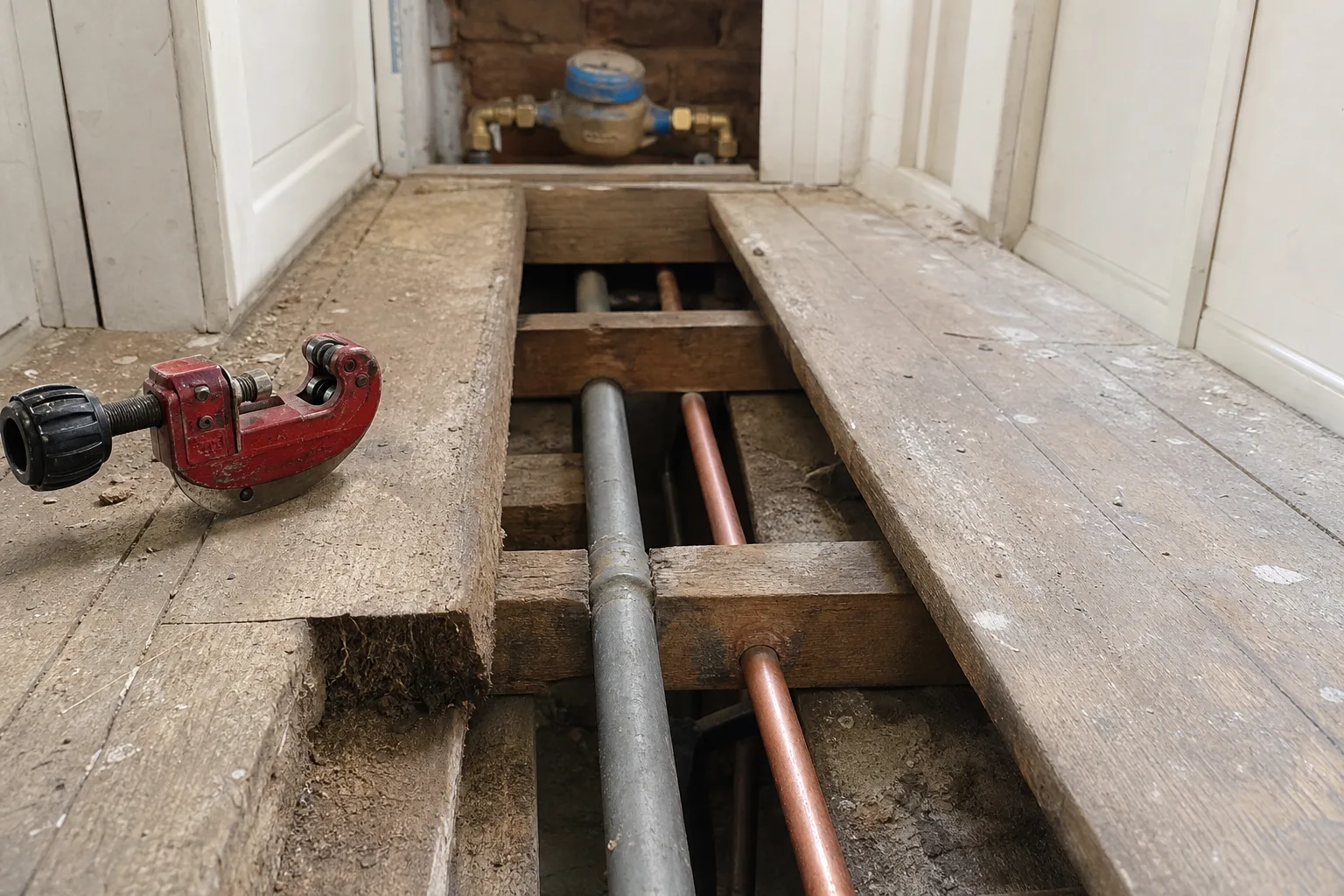
Many older Dutch houses have a timber floor on joists, on the ground floor or upstairs. You cannot simply pour levelling compound on it, because wood moves and a hard levelling layer will crack. First we screw down loose boards and replace anything rotten. With a ground floor we check the crawl space for damp and ventilation.
We then usually cover the floor with sturdy boards, glued and screwed. A floating floor can go straight on top, or a thin levelling compound made for timber bases is applied. In an apartment with a timber upper floor we also check the VvE's noise rules; read a new floor in an apartment.
Ventilation and the price
Ventilation matters during and after the work. Milieu Centraal points out that solvent based products contain volatile organic compounds that are bad for health, and advises ventilating well after laying, especially with glued floors. Levelling compound also needs fresh air to dry, though without a strong draught: drying too fast causes cracks.
The cost of preparation depends on what is there now and its condition: removing old floors, how much repair is needed, the thickness of the levelling layer, and whether a timber floor has to be fixed and covered first. We do not quote fixed prices, but list preparation separately in the quote, so you can see what is needed and why. See our flooring service, read parquet or PVC flooring or ask for a free quote.
Frequently asked questions
Is levelling always necessary?
Not always. A floating floor on an underlay tolerates small irregularities. Glue-down PVC and bonded parquet do need a flat, smooth subfloor, and levelling is then usually part of the job.
Can you level over old tiles?
Often yes, if the tiles are firmly fixed and the floor is solid. The tiles are degreased, the joints filled and a bonding primer applied before levelling.
How long does levelling compound take to dry?
That depends on product, thickness, temperature and ventilation. A thin layer is often ready in a few days, a thick layer takes longer. Moisture should be measured before laying.
Can I remove the old vinyl floor myself?
Vinyl sheet or tiles from before 1985 may contain asbestos in the backing or the tiles. Have that checked before you start pulling or scraping.
Can you level on a timber floor?
Not directly on loose boards. The floor is first fixed down and usually covered with boards. After that a levelling compound suitable for timber, or a floating floor, can go on.
Renovation and finishing work from Roelofarendsveen: plastering, bathrooms, microcement, extensions, insulation, floors, electrics and plumbing. One point of contact from quote to completion. Questions? Call or WhatsApp +31 6 87 61 60 78.
Sources
- Asbestos in and around the home, in Dutch (Milieu Centraal)
- Asbestos survey requirement, in Dutch (IPLO)
- Floors and floor coverings, in Dutch (Milieu Centraal)
Rules change. Always check your own address with the Permit Check (Vergunningcheck) in the Omgevingsloket or with your municipality.