- According to the Dutch government, only homes built before 1960 can still have lead pipes in use.
- Lead is grey, slightly irregular in shape, has swollen joints and sounds dull when you tap it.
- The owner replaces the pipes from the water meter into the home; the water company replaces the part to the street.
- Until replacement: bottled water for pregnant women and young children, and run the tap before use.
- A renovation is the moment to renew other old water and drainage pipes as well.
Which homes are affected
According to the Dutch government, only homes built before 1960 can still have lead pipes in use. Milieu Centraal, the independent Dutch information service, is more precise: lead was standard in houses built before 1945, and houses from 1945 to 1960 may also have lead pipes inside. If your house was built after 1960, Milieu Centraal says there will be no lead pipes.
Many of those older homes have been renovated at some point. That is still no guarantee. The government points out that pipes under floors and in walls may still be lead, even if the visible pipes have been replaced. With a bathroom or kitchen renewed in the 1980s we regularly find that the supply from the meter is still the original piece of lead.
How to recognise lead pipes
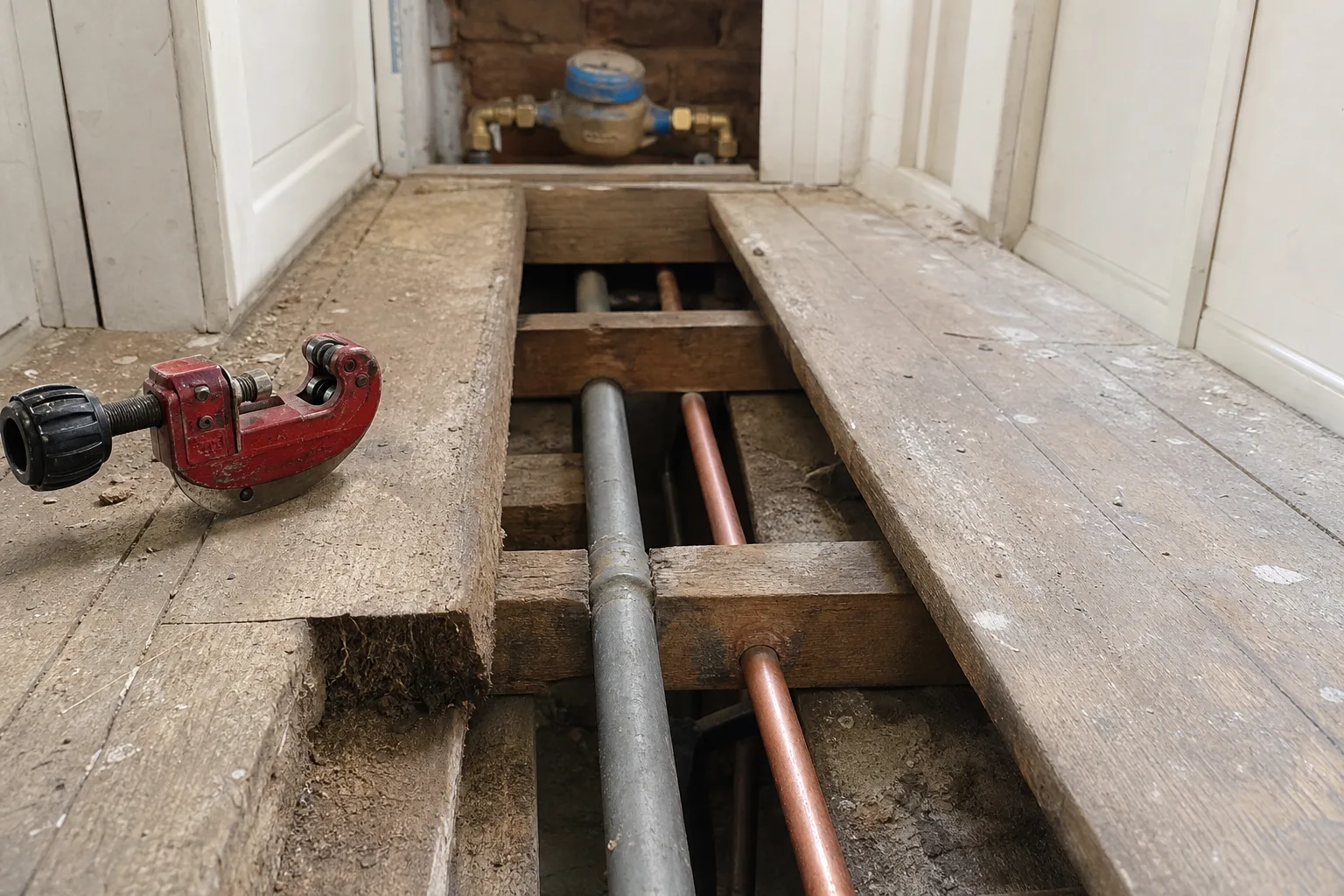
Start at the water meter, usually in the meter cupboard by the front door. That is where the water company's pipe ends and your own begins. Follow it as far as you can. Milieu Centraal describes lead pipes as grey and slightly irregular in shape. The joints are not separate fittings but a swelling in the pipe itself. Tap it, and a lead pipe sounds duller than copper or iron.
Sometimes the pipes are hidden from view, for example in the front garden or under a stone hallway floor. If in doubt, have the water tested. A stagnation test measures the lead content of water that has stood in the pipe for a while. In Amsterdam, Waternet, the city's water company, explains in English how owners can request a test. A plumber can also check what is there during a site visit.
- Colour: dull grey, silvery where scratched.
- Shape: not quite straight, slightly wavy.
- Joints: a swelling in the pipe, no separate fitting.
- Sound: dull when tapped, not bright like copper.
- Location: often from the meter under the hallway floor or in the wall.
Who is responsible
The Dutch government draws a clear line at the water meter. The water company replaces the section from the meter to the street. The owner of the building replaces lead pipes from the meter into the home. According to Milieu Centraal, almost all water company pipes up to the meter have already been replaced. Waternet reports that it replaced the lead pipes outside houses in Amsterdam in the 1990s.
If you own your home, you hire a plumber yourself. If you rent, the landlord is responsible. If they do nothing, the government says you can report it as a serious defect to the Huurcommissie, the independent rent tribunal. In an apartment building some pipes may be shared, so you will need to talk to the VvE, the owners' association. The government also suggests asking your municipality (gemeente) whether a subsidy is available for replacing lead pipes.
Tip from the trade: When buying a house built before 1960, always ask about the water pipes. A standard building survey does not always cover them.
Ze hebben in 1 week tijd de hele beneden verdieping stucwerk gerepareerd, geschilderd en gesausd tot volle tevredenheid. Netjes en accuraat gewerkt, flexibel geweest en vakwerk afgeleverd. Dus top.
What to do until the pipes are replaced
Lead in drinking water is mainly a risk for babies, including during pregnancy, and children under 7, Milieu Centraal writes. The government advises drinking bottled water until the pipes are replaced and running the tap well before using tap water. Milieu Centraal advises pregnant women and young children not to drink tap water and to prepare formula with bottled or cartoned water.
Running the tap helps, but according to Milieu Centraal it does not make the water truly lead free. Only replacement solves it. So do not put it off, and certainly not if a baby is on the way.
How we replace pipework
We start at the water meter and replace the pipe from there to every tap: kitchen, bathroom, toilet, washing machine and the boiler. For the new pipes we use copper or multilayer plastic pipe, depending on the route and the situation. Where possible we run the new pipes through the crawl space, along skirting boards or in existing ducts, to keep breaking out to a minimum.
If that is not possible, we cut channels in the wall or floor and finish them afterwards with plaster or a new floor. After connecting, the system is pressure tested and flushed thoroughly. Waternet notes that new taps or pipes can also release some lead for a while, and advises running the tap or shower after long periods without use. During the work the water is off for a few hours; we plan that with you.
- Site visit: route from the meter and every tap.
- Choice of material: copper or multilayer pipe.
- Route via crawl space, duct or channel.
- Pressure testing, flushing and connecting.
- Making good plaster, tiles or flooring.
Renewing other old pipework too
If the floor or wall is being opened anyway, it makes sense to look beyond lead. Galvanised steel pipes can clog up inside, which gives low water pressure. Old cast iron or early plastic drains can leak or have too little fall. Pipes where water stands still for long periods, such as a capped pipe to an old kitchen, are also better removed.
In a renovation we often combine this with a new bathroom or kitchen, so the new pipes end up exactly where the new fittings will go. See our bathroom renovation and full renovation pages. If a new floor is going in as well, read levelling and preparing a subfloor.
What the price depends on
The price depends on the length of the pipes, the number of taps, access via a crawl space or duct, and how much breaking out and making good is needed. A ground floor flat with a crawl space is often simpler than an upper floor flat with concrete floors and pipes in the walls.
The material, repairs to plaster, tiles or floor, and the combination with other work also count. At Parus the same team handles pipework, plastering and flooring. After the site visit you receive a quote per item. See our plumbing service or ask for a free quote. We reply within 24 hours.
Frequently asked questions
How can I be sure I have lead pipes?
Look at the water meter and follow the pipe. Lead is dull grey, slightly irregular and sounds dull when tapped. You only know for certain with a water test or a plumber's inspection.
Am I obliged to replace lead pipes?
The Dutch government states that the owner replaces the pipes from the water meter into the home, and tenants can hold their landlord to this. For what that means legally in your case, contact the Juridisch Loket, the free Dutch legal advice service.
Is there a subsidy?
That varies by municipality. The Dutch government suggests asking your gemeente whether a subsidy is available for replacing lead pipes.
How long will I be without water?
Usually a few hours on the days the new pipe is connected. We plan that with you in advance.
Can I filter the water instead of replacing the pipes?
Milieu Centraal and the Dutch government advise replacement. Running the tap helps for now, but according to Milieu Centraal it does not make the water truly lead free.
Renovation and finishing work from Roelofarendsveen: plastering, bathrooms, microcement, extensions, insulation, floors, electrics and plumbing. One point of contact from quote to completion. Questions? Call or WhatsApp +31 6 87 61 60 78.
Sources
- Lead pipes in the home (Waternet, Amsterdam)
- Finding and replacing lead pipes, in Dutch (Rijksoverheid)
- Lead pipes in your home, in Dutch (Milieu Centraal)
Rules change. Always check your own address with the Permit Check (Vergunningcheck) in the Omgevingsloket or with your municipality.